

Splinting and Stretch Protocol for Pediatric Trigger Thumb
Filed under Treatments
Tan, A. C., Lam, K. S., & Lee, E. H. (2002). The Treatment Outcome of Trigger Thumb in Children. Journal of Pediatric Orthopaedics B, 11(3), 256-259.
The Skinny:
Pediatric trigger thumb is a “relatively uncommon” condition of unknown origins. Studies have indicated that spontaneous recovery of trigger thumb is around 25-40%, and chances increase with age. Meanwhile, implementation of conservative treatment splint therapy, in conjunction with passive stretch programs (pediatric trigger thumb exercises), have shown successful recovery rate as great as 89%.
This review analyzes the success of nighttime/naptime only thumb extension orthotic wear in conjunction with a passive stretch exercises protocol (pediatric trigger finger exercises).
In the Weeds:
115 patients with noted flexion contracture deformity or present triggering/snapping were reviewed. Boys and girls were equally affected, as were left and right thumbs. 23 children had bilateral thumb involvement.
59 children, with an average age of 26.5 months, were treated surgically with A1 pulley release. 56 children, with an average age of 19 months, were treated conservatively with splint therapy.
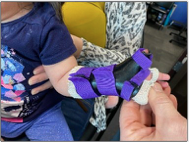
Splint therapy consisted of nighttime/naptime wear of a thumb extension orthotic (see image) with regular clinic sessions for passive stretch to the thumb, and splint modifications to increase thumb/IP extension (pediatric trigger thumb splint).
Bringing It Home:
Conservative treatment showed an overall success rate of 66%. The success rate decreased with increasing age: from 89% in the under 1 year-old age group to 50% in the over 3 year-old old age group.
Of the 56 patients having conservative treatment, 31 had splint therapy and 25 had passive stretch only. Splint therapy resulted in 77% success rate compared to 52% with the stretch-only group, demonstrating that use of orthotic in conjunction with passive stretch shows the best recovery. Overall, 76% of patients were successfully treated conservatively within 6 months.
For those patients who underwent surgery, either initially or after failed conservative treatment, 1.4% had a recurrence of triggering, and 2.8% had subsequent wound infection requiring treatment with antibiotics.
Limitations: This article asserts that trigger thumb in pediatrics is most likely attributed to acquired injury rather than a congenital anomaly, as none of the participants presented with trigger thumb prior to
six months of age. However, this overlooks the concept that indwelling thumb is developmentally appropriate up through 5 months of age, so observation of thumb IP flexion or thumb flexion prior to
this age would not indicate referral, even if trigger thumb may be co-occurring.
The article does not directly compare the success rates of surgical versus conservative treatment methods. It explains the success rates of conservative treatments while only stating the failure rates of
surgical intervention, which skews the statistics against each other.
More To Read
Is therapy needed after a distal radius fracture?
Coughlin T, Norrish AR, Scammell BE, Matthews PA, Nightingale J, Ollivere BJ. Comparison of rehabilitation interventions in nonoperatively treated distal radius fractures: a randomized controlled trial of effectiveness. Bone Joint J. 2021Jun;103-B(6):1033-1039. doi: 10.1302/0301-620X.103B.BJJ-2020-2026.R1.Epub 2021 Apr 30. PMID: 33926211. The Skinny: Individuals with distal radius fractures are very common in the hand therapy world. This…
Read More
Effects of different stretching techniques for improving joint range of motion.
Reference: Oba, K., Samukawa, M., Abe, Y., Suzuki, Y., Komatsuzaki, M., Kasahara, S., Ishida, T., & Tohyama, H. (2021). Effects of Intermittent and Continuous Static Stretching on Range of Motion and Musculotendinous Viscoelastic Properties Based on a Duration-Matched Protocol. International journal of environmental research and public health, 18(20), 10632. https://doi-org.libproxy.nau.edu/10.3390/ijerph182010632 The Skinny: This study used a cross-over…
Read More
An evaluation of wrist and forearm range of motion during purposeful activities and exercises for distal radius fracture
An evaluation of wrist and forearm movement during purposeful activities and range of movement exercises after surgical repair of a distal radius fracture: A randomized crossover study Collis, J., Mayland, E., Wright-St Clair, V., Rashid, U., Kayes, N., & Signal, N. 2022. An evaluation of wrist and forearm movement during purposeful activities and range of…
Read More
Hand Therapy as a New Grad or Student
Tips for Getting Prepared for hand therapy as a new grad or a Level II Fieldwork Everything you need to know in hand therapy starts with the upper extremity anatomy. Here is a quick checklist to review and hopefully help get you started in your new hand therapy setting. By: Tristany Hightower I suggest, as…
Read More
Sign-up to Get Updates Straight to Your Inbox!
Sign up with us and we will send you regular blog posts on everything hand therapy, notices every time we upload new videos and tutorials, along with handout, protocols, and other useful information.