

Hand Therapy: Does Dry Needling work to Treat Trigger Finger
Filed under Uncategorized
By: Taylor Volentine
Reference:
Azizian, M., Bagheri, H., Olyaei, G., Shadmeher, A., Okhovatpour, M. A., Dehghan, P., Jalaei, S., Sarafraz, H. (2019). Effects of dry needling on tendon-pulley architecture, pain and hand function in patients with trigger finger: a randomized controlled trial study. The Journal of Physical Therapy Science, 31. 295-298. doi:10.1589/jpts.31.295

Photo retrieved from https://www.vitalitychiropractor.com.au/dry-needling/
The Skinny:
The article seeks to address if dry needling for trigger finger is an effective mechanism to improve overall hand function and reduce pain in individuals. The medical terminology for trigger finger is known as stenosing tenosynovitis. Trigger finger displays a locked or bent position of the finger or when the finger “pops” during movement, hence the name trigger finger. When the flexor tendon sheath becomes too thick or inflamed it becomes difficult to glide through the pulley (Mayo Clinic, 2017).
Individuals who tend to participate in activities that require continuous gripping actions are at greater risk of trigger finger. If your client presents with trigger finger, they may acquire finger stiffness, finger locking and bent position, pain and tenderness of nodule surrounding the pulley, and popping or clicking during movement (Mayo Clinic 2017). Trigger finger may be treated by immobilizing the joint with a finger orthosis at the A1 pulley to promote healing, gentle exercises, avoidance of activities that involves grasping, steroid injections, and surgery if trigger finger becomes severe (Mayo Clinic, 2017).
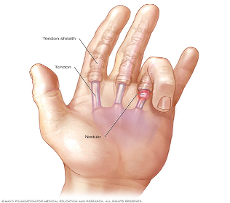
Photo retrieved from https://www.mayoclinic.org/diseases-conditions/trigger-finger/symptoms-causes/syc-20365100
In The Weeds:
This article was conducted as a randomized controlled trial with 58 participants who had trigger finger with the population ranging from 45-75 years of age. The participants were selected if they acquired the following: Unilateral idiopathic trigger finger with grade 1, 2, or 3 according to quinnell classification for at least four weeks, pain and tenderness at the location of the A1 pulley, palpation of inflamed nodule, pain and tenderness while digit flexion and extension, and locking or clicking of finger during movement (Azizian et al., 2019).
The 58 participants were randomly split evenly into two groups: the control group who did not receive dry needling treatment, and the intervention group who received dry needling treatment. The intervention group received 1 treatment of dry needling to the A1 pulley region from a therapist with 5 years of experience with dry needling and blinded to the outcomes of the study. The needle was inserted 45 degrees at the metacarpophalangeal level to nodule utilizing the fast in and fast out cone shape mechanism (Azizian et al., 2019).
Results were obtained through pre and posttest assessments measuring pain, DASH questionnaire, tendon-pulley architecture, pulley tendon thickness, and pinch grip to compare outcomes of one treatment session of dry needling. Results showed significant improvements with pain, hand function, and pulley architecture from the intervention group compared to the control group. There was not a significant difference with the control group.
Bringing It Home:
Based on the findings of this research article, trigger finger dry needling can be used as another treatment mechanism to improve overall hand function and reduce pain and pulley tendon thickness for individuals with trigger finger. Therapists may use a combination of dry needling and splinting to immobilize the movement of the A1 pulley to decrease inflammation and pain to be able to complete daily occupations.
This article portrays valuable information in regard to dry needling as an intervention to promote healing for individuals with trigger finger. This article has limitations which may have resulted in different outcomes.
· Only one dry needling treatment session providing short-term outcome data
· Limited data to compare findings
· Small sample size
Overall this article demonstrated promising data in regard to dry needling hand therapy as an effective mechanism to improve the effects of trigger finger and overall hand function. Additional research is needed to compare results with and long-term effects of dry needling.
Additional References
Mayo Clinic. (2017). Trigger Finger. Retrieved from https://www.mayoclinic.org/diseases-conditions/trigger-finger/symptoms-causes/syc-20365100
More To Read
Scar Wars: Scar Management Techniques
We will briefly discuss Scar Management Options and Techniques
Read More
Video Augmented Hand Therapy after CVA with hemiplegia.
The previous rapid review discussed the positive outcomes of video-augmented hand therapy after a CVA with hemiplegia. Please watch this vlog to discover how to make the video augmented box to make it easily integrated into your clinic. Video By: Shannon Skowbo
Read More
Wrist Proprioception Ideas for Hand Therapy
Wrist Proprioception Intervention Ideas: By Ammie Ingwaldson Lack of wrist proprioception exercises can affect clients in the hand therapy setting with neurological and musculoskeletal conditions. Proprioception limitations are found in common conditions such as carpal tunnel syndrome, distal radius fracture, and CRPS (Valdes, Naughton & Algar, 2014). Proprioception is necessary during daily tasks to provide…
Read More
Mirror therapy after a peripheral nerve repair in hand therapy
Rapid Review Paula, M. H., Barbosa, R. I., Marcolino, A. M., Elui, V. M., Rosén, B., & Fonseca, M. C. (2016). Early sensory re-education of the hand after a peripheral nerve repair based on mirror therapy: a randomized controlled trial. Brazilian journal of physical therapy, 20(1), 58–65. https://doi.org/10.1590/bjpt-rbf.2014.0130 The Skinny: Therapy is often provided following an…
Read More
Sign-up to Get Updates Straight to Your Inbox!
Sign up with us and we will send you regular blog posts on everything hand therapy, notices every time we upload new videos and tutorials, along with handout, protocols, and other useful information.