

Comparison of Custom-made Versus Prefabricated Thumb Splinting for Carpometacarpal Arthrosis: A Systematic Review and Meta-analysis
Filed under Reviews, Uncategorized
Baradaran, A., Baradaran, A., Ebrahimzadeh, M. H., Kachooei, A. R., Rivlin, M., & Beredjiklian, P. (2018). Comparison of Custom-made Versus Prefabricated Splint for Carpometacarpal Arthrosis: A Systematic Review and Meta-analysis. The archives of bone and joint surgery, 6(6), 478–485.
Article Review By: Dalton Busch
The Skinny – A systematic review and meta-analysis were composed to compare the effectiveness of prefabricated orthoses versus a custom-made thermoplastic splint. The splints were created to manage carpometacarpal (CMC) osteoarthritis (OA). A total of five randomized clinical trials with a total of 230 patients were analyzed following the Preferred Reporting Items for Systematic Reviews and Meta-Analyses (PRISMA) guidelines.
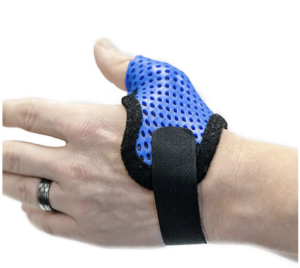
In the weeds – Within the five randomized controlled trials, the researchers analyzed patients’ disability scores, pain scores, grip, and pinch strength, and integrated the data properly. All of the trials assessed were comparing results of the CMC OA orthoses as a non-surgical alternative. The primary outcome measure included was the Disabilities of the Arm Shoulder and Hand (DASH). Secondary measures that were extracted by the researchers included pain ratings, grip strength, and pinch strength. Further, the researchers looked into overall demographics, sample size, study design, and the type of splint utilized on the affected thumb.
Bringing it home – Overall findings from the systematic review pointed towards a statistical difference in the overall disability scores of patients who wore the prefabricated versus the custom, showing preference to the prefabricated. The secondary data relating to pain and grip/pinch strength both showed overall improvement wearing either the prefabricated or custom-made orthotic.
Rating (0-5) – 4: This systematic review and meta-analysis were done across five clinical trials with a large sample size of 230 patients. The review shows the effectiveness of both custom and prefabricated orthoses but shows lessened disability scores for prefabricated. The mean follow-up testing was 8.1 weeks which is a short-term retest as CMC OA orthoses could become a lifelong solution for patients who fall within this category. Improved research may look into long-term follow-up for more accurate data.
1 Comment
Leave a Comment
More To Read

Effects of different stretching techniques for improving joint range of motion.
Reference: Oba, K., Samukawa, M., Abe, Y., Suzuki, Y., Komatsuzaki, M., Kasahara, S., Ishida, T., & Tohyama, H. (2021). Effects of Intermittent and Continuous Static Stretching on Range of Motion and Musculotendinous Viscoelastic Properties Based on a Duration-Matched Protocol. International journal of environmental research and public health, 18(20), 10632. https://doi-org.libproxy.nau.edu/10.3390/ijerph182010632 The Skinny: This study used a cross-over…

Article Review: Relative Motion for Extensor Tendon Repair zone V-VI? Is a night-time resting hand orthosis beneficial?
Hirth, M. J., Hunt, I., Briody, K., Milner, Z., Sleep, K., Chu, A., Donovan, E. & O’Brien, L. (2021). Comparison of two relative motion extension orthotic programs following surgical repair of finger extensor tendons in zones V-VI: A randomized equivalence trial. Journal of Hand Therapy-to be published. The Skinny: Following a zone V-VI tendon repair,…

A randomized clinical trial comparing early active motion programs: Earlier hand function, TAM, and orthotic satisfaction with a relative motion extension program for zones V and VI extensor tendon repairs
By Brittany Day Collocott SJ, Kelly E, Foster M, Myhr H, Wang A, Ellis RF. A randomized clinical trial comparing early active motion programs: Earlier hand function, TAM, and orthotic satisfaction with a relative motion extension program for zones V and VI extensor tendon repairs. Journal of Hand Therapy. 2019. doi:10.1016/j.jht.2018.10.003 The Skinny- This is…

Which is better: Splinting the MCP or PIP joint when managing Trigger Finger?
Teo, S. H., Ng D. C., Wong, Y.K.(2018). Effectiveness of proximal interphalangeal joint blocking orthosis vs metacarpophalangeal joint blocking orthosis in trigger digit: A randomized clinical trial. Journal of Hand Therapy, 1-7. The Skinny- This study compared PIP joint immobilization via an Oval-8TM with a custom MCP blocking trigger finger orthosis treatment. In the Weeds…

Sign-up to Get Updates Straight to Your Inbox!
Sign up with us and we will send you regular blog posts on everything hand therapy, notices every time we upload new videos and tutorials, along with handout, protocols, and other useful information.
This doesn’t surprise me as I think there is a high variability between therapist custom splint designs which may outweigh the potential benefit of having the splint custom fabricated.